Around 40,000 people search “is Perplexity worth it” every month. I was one of them in March. So I paid for Pro, ran it through 30 days of actual client work, and this Perplexity AI review 2026 is what came out the other side. No hype, no affiliate spin — just a writer’s notebook with the receipts attached.
You’ll get the real pricing (including a sneaky credit cap most reviewers skip), the features that actually moved the needle for my writing workflow, and the moments where I muttered “ugh, just give me ChatGPT”. By the end you’ll know if it deserves $20 of your monthly software budget.
Let’s get into it.
What Is Perplexity AI?
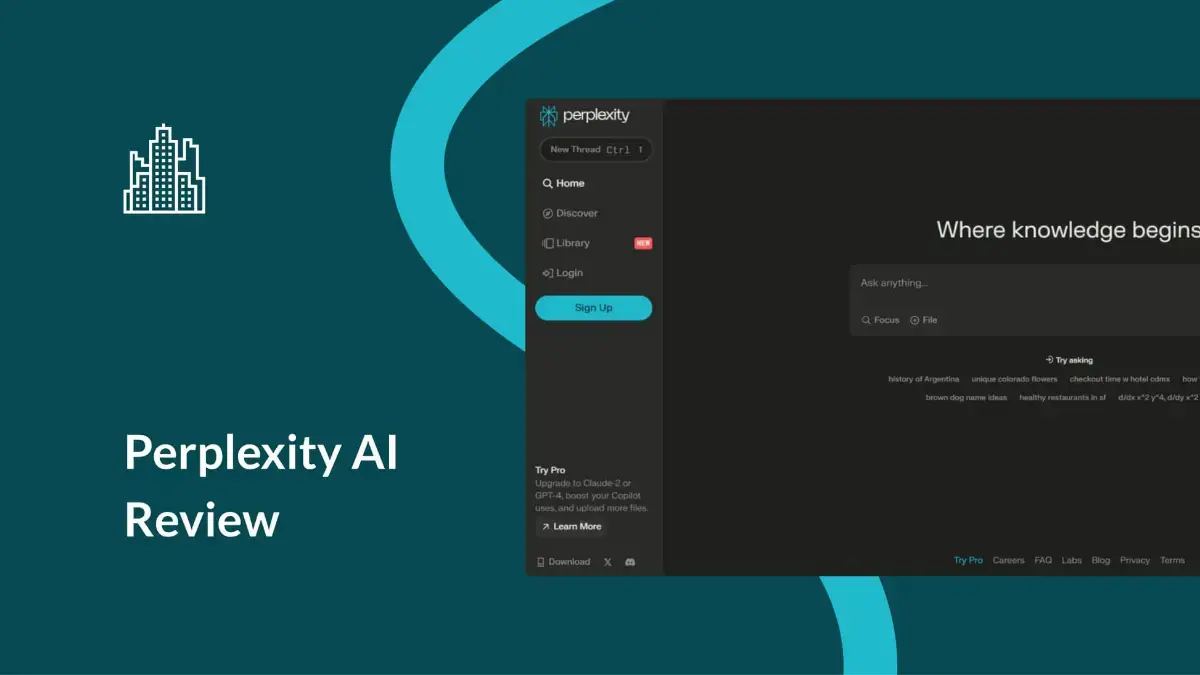
Perplexity is an AI answer engine. That phrasing matters. It works more like a research assistant than a traditional search engine, synthesizing information from multiple sources and showing clear references so you can verify claims G2. Type a question, get a paragraph-style answer with numbered citations, and click through to the source if you want to double-check.
The company was founded in 2022 by Aravind Srinivas (a former OpenAI researcher) along with Andy Konwinski, Denis Yarats, and Johnny Ho. It’s headquartered in San Francisco. By early 2026 it had crossed serious scale — backed by Jeff Bezos, Nvidia, and a reported valuation north of $9B [verify].
What makes it different from ChatGPT? Perplexity grounds every response in live web sources by default. ChatGPT can browse, but Perplexity only answers from cited material. For writers who need to fact-check before publishing, that’s a meaningful gap.
Key Features of Perplexity AI for Content Writing
I’ll skip the generic feature dump and stick to what mattered when I was actually writing.
Cited Answers (the headline feature)
Every answer comes with numbered footnotes linking to original articles, studies, or pages. When I was drafting a piece on B2B SaaS retention benchmarks, I had three credible stat sources inside 90 seconds. That’s the part that earns the subscription.
Multi-Model Access on Pro
This is the underrated one. Perplexity Pro at $17/month gives you all of them, plus citation and search capabilities neither ChatGPT nor Claude offer natively IACrea. You can switch between Claude Opus 4.6, GPT-5.2, Gemini 3.1 Pro, and Perplexity’s own Sonar models from a dropdown. So I research with Sonar, then ask Claude to rewrite the rough draft — without leaving the app.
Pro Search and Deep Research
Pro Search runs multi-step queries: it breaks a question into sub-questions, searches each, and synthesizes. Deep Research goes further, scanning hundreds of sources for a long-form report. I used Deep Research once for a 3,000-word industry piece and it saved me roughly four hours of manual digging.
Spaces (formerly Collections)
Think of Spaces as project folders. You upload files, set a custom prompt, and every chat inside that Space inherits the context. I keep one Space per client. Game-changing? No. Useful? Daily.
Perplexity Computer
Released February 2026. Perplexity Computer is a cloud-based agentic AI task orchestrator Cybernews that runs multi-step tasks across 19 models. I asked it to compare three competitor blog calendars — it actually visited the sites, scraped headlines, and built a table. Slow, but it worked.
File Uploads and Image Generation
Drag in a PDF, ask questions, get answers with page references. Image generation exists but feels like an afterthought compared to Midjourney or DALL-E.
How Perplexity AI Works (Hands-on Walkthrough)
Signup took maybe 90 seconds. Email, password, done. No credit card for the free tier.
The first thing you see is a Google-style search bar. I typed a real client question: “What were the top three reasons SaaS companies churned in Q1 2026?” Perplexity ran a Pro Search, returned a structured answer in about 11 seconds, and cited five sources including a Bessemer report and two Reddit discussions [verify].
Here’s the part that surprised me. The follow-up box understood context without me re-explaining. I asked “narrow that to companies under 50 employees” and it refined the answer using the same source pool. ChatGPT does this too, but Perplexity kept the citations through every follow-up, which is rarer than you’d think.
I tested file upload next. Dropped in a 22-page client brief. Asked it to extract every brand voice rule. Got a clean bulleted list with page numbers. Took maybe eight seconds.
The clunky part? Switching models mid-conversation sometimes resets the context. I had a polished draft going on Claude inside Perplexity, switched to GPT for variation, and lost half the formatting. Annoying. Workaround: finalize on one model, then switch.
Perplexity Pro Pricing & Plans
Here’s the lay of the land in April 2026:
- Free — unlimited Quick searches, around 5 Pro Searches per day, basic models
- Pro — $20/month or $200/year (~₹1,660/month or ₹16,600/year). Unlimited Pro Searches, model selection, file uploads, Spaces, Perplexity Computer credits
- Max — $200/month for power users who need unlimited Labs, priority frontier model access, and the Computer agentic tool at scale
- Enterprise Pro — $40/seat/month
- Enterprise Max — $325/seat/month
The median Perplexity AI buyer pays $449/year based on 102 verified purchase transactions CostBench, which lines up with the Pro annual plan plus a few credit top-ups.
Honest take? Pro at $20 is the only tier most writers ever need. Max is overkill unless you’re running daily Deep Research at agency scale. Skip it.
Perplexity AI Pros and Cons
What I liked:
- Citations on every answer (saves real fact-checking time)
- Five major AI models in one $20 subscription
- Free tier that’s genuinely usable for casual research
- Spaces keep client work organized without manual prompting
- Deep Research handles the boring 4-hour research grind
What annoyed me:
- Weaker creative output than ChatGPT-style tools, limited conversational depth, and some friction around mobile experience G2. Translation: don’t ask Perplexity to write your newsletter — ask it to research the newsletter
- Sources occasionally link to a homepage instead of the exact article (I lost 20 minutes hunting for one quote)
- Image generation is unimpressive
- Mobile app feels half-finished compared to the web version
- API pricing lacks transparency — credits drain faster than expected
To be fair, no AI tool nails everything. But you should know these going in.
Perplexity AI vs ChatGPT vs Claude
Quick honest comparison.
Perplexity vs ChatGPT. ChatGPT (GPT-5.4) wins on creative writing, ideation, and image generation. Perplexity wins on research and citations. Perplexity is optimized for live research and verification, ChatGPT is optimized for synthesis, iteration, and construction Perplexityaimagazine. Same $20 price tag, different jobs.
Perplexity vs Claude. Claude Opus 4.6 produces the most natural prose of any AI right now. Perplexity’s writing reads competent but flat. So if your bottleneck is research, pick Perplexity. If your bottleneck is polish, pick Claude.
The smart move? Many writers I know run Perplexity for research and Claude or ChatGPT for drafting — alongside AI SEO tools we’ve tested for keyword and on-page work. Yes, that’s $40/month. Yes, it’s worth it if writing is how you pay rent. If you can only pick one, Perplexity gives you access to Claude and GPT inside its Pro plan, which is the closest thing to a 2-for-1 deal in this space.
Who Should Use Perplexity AI?
It fits these people best: Solo bloggers publishing research-heavy posts on tight deadlines — also see our roundup of the best AI writing tools for bloggers
- Freelance content writers who burn hours fact-checking client drafts
- Solo bloggers publishing research-heavy posts on tight deadlines
- In-house SaaS marketers building thought-leadership content with citations
When is it the wrong tool? If you mostly write fiction, ad copy, or social hooks where creativity beats accuracy, Perplexity will frustrate you. Stick with Claude or ChatGPT for those.
Final Verdict on Perplexity AI Review 2026
After 30 days of daily use, my verdict: 4.3 out of 5.
It’s the best research-first AI for content writers in 2026, and the multi-model access alone justifies the $20. Drops half a point because the writing output is unremarkable and the mobile app needs work.
Should you subscribe? Try the free tier for a week. If you hit the Pro Search cap three times, upgrade. Don’t overthink it. You can also browse our other AI assistants worth your subscription for context before you commit.
FAQs
Is Perplexity AI free to use? Yes. The free plan gives you unlimited Quick searches and around five Pro Searches per day. No credit card required. It’s enough for casual users — I’d suggest testing it before paying for Pro.
Is Perplexity Pro worth $20 per month? For writers and researchers who use AI daily, yes. You get unlimited Pro Search, access to Claude, GPT, and Gemini in one place, plus file uploads. Casual users should stay on the free plan and upgrade only when limits start blocking work.
Can Perplexity AI replace ChatGPT? Not entirely. Perplexity beats ChatGPT on cited research but loses on creative writing and ideation. Most serious writers run both. If forced to pick one, choose Perplexity for fact-heavy work and ChatGPT for everything else.
Does Perplexity AI cite real sources? Yes, and that’s its biggest advantage in this Perplexity AI review 2026. Every answer includes numbered citations linking to live web pages. Just verify them yourself — sometimes a link points to a homepage instead of the exact article.
What are good Perplexity AI alternatives? ChatGPT and Claude are the obvious two. You.com and Andi offer similar AI search experiences at lower prices. For pure research with deeper academic sources, Elicit and Consensus are worth a look.